
Estimate first, then firm bid
Example ranges help with planning, but Oreniss still reviews the current environment, customer workspace needs, and scope before confirming a responsible fixed project path.
Oreniss pricing is built for SMBs that need managed outcomes rather than open-ended tool seats. Work can be quoted as a scoped project, assisted setup package, Oreniss Token-funded execution, or maintenance plan, with approvals and customer-visible billing context before anything becomes billable.
Example ranges help with planning, but Oreniss still reviews the current environment, customer workspace needs, and scope before confirming a responsible fixed project path.
Human-assisted setup, infrastructure help, customer-facing updates, and operator-coordinated delivery lines stay behind explicit approval before they become billable.
Oreniss keeps local customers, token balances, invoices, invoice events, and case-linked billing visibility authoritative even when Stripe handles hosted invoices, checkout, and automatic tax.
Oreniss Tokens are the customer-facing unit for approved agent runs, repeat requests, maintenance batches, and assisted automation inside an Oreniss workspace.
Approved agentic work draws down the token balance as tasks run, complete, and reconcile. The exact debit depends on the accepted scope, recorded run activity, and any human-assisted review needed for the work.
Selecting a tier is not a live charge. Purchases require the approved checkout or invoice path, and live billing only proceeds after the customer confirms the payment boundary.
Confirm the checkout or invoice path before a token purchase becomes billable.
Purchased Oreniss Tokens land in the customer-visible balance and ledger.
Approved agent runs, repeat requests, and maintenance batches draw from the balance.
Usage, invoices, and maintenance history stay attached to the same workspace.
Small follow-up batch, lightweight agent run, or first maintenance request.
Monthly request batch, portal adjustments, and several approved agent runs.
Active workspace maintenance, implementation batches, and recurring automation work.
Larger agentic delivery queue, ongoing product work, or multi-surface support.
High-volume maintenance, repeat delivery work, and sustained agent-assisted operations.
Best for defined website, integration, automation, AI-agent, or product work with a clear acceptance path.
Best for: Customers who can describe a clear outcome and want Oreniss to convert that scope into a responsible fixed project path.
Typical range: USD 750 to USD 15,000+ Estimate first, firm bid after review, contract before delivery.A website rebuild, customer portal, or workflow implementation where the business goal is clear but the exact delivery scope still needs review.
The reviewed scope becomes a fixed project invoice line only after the firm bid, responsibilities, and contract path are accepted.
Scope changes create a new approval item instead of silently changing the invoice.Best when access, environment setup, credentials, content, or stakeholder review needs operator coordination.
Best for: Projects where manual access coordination, content collection, setup help, or approvals are part of the real delivery cost.
Typical range: USD 150 to USD 2,500+ Billed as setup lines, approved work items, or case-specific invoice items.An operator helps with launch access, browser or connector installation, content uploads, stakeholder coordination, or secret-safe setup tasks before execution can continue.
Connector help, content loading, access coordination, or stakeholder review is listed as an assisted setup line before it can become an invoice candidate.
No setup line becomes billable until the customer approval gate is satisfied.Best for repeat requests, maintenance, agent runs, and task batches inside the same customer workspace.
Best for: Customers who expect recurring tasks, iterative improvements, or maintenance work in the same reusable workspace.
Token bundles: USD 100 to USD 3,000 before tax Five prepaid tiers use 100, 500, 1,000, 2,500, and 5,000 tokens with 0, 10, 20, 30, and 40 percent discounts.A customer keeps one workspace open for monthly request batches, portal improvements, agent runs, billing tweaks, or maintenance follow-up work.
A monthly batch of portal tweaks or agent runs draws from an approved Oreniss Token balance recorded in the local ledger.
Token debits follow approved work items and reconciled agent-run usage; checkout opens only inside approved billing boundaries.Best for post-launch support, monitoring, updates, content changes, small automations, and periodic improvements.
Best for: Customers who want continuity after launch without starting a new procurement process for every small improvement.
Typical range: USD 250 to USD 5,000+ per month Maintenance can combine reserved capacity, Oreniss Tokens, and approved invoice lines.A delivered website, portal, or workflow moves into a support path that covers updates, fixes, content changes, and repeat technical improvements.
A support month can combine reserved maintenance capacity, Oreniss Tokens, and approved support invoice lines.
Renewal and support changes stay explicit before the next invoice candidate is created.These examples show how scoped work, assisted setup, Oreniss Tokens, invoices, and maintenance become customer-visible billing context inside the same workspace. They explain planning paths and do not execute Stripe or ledger changes.
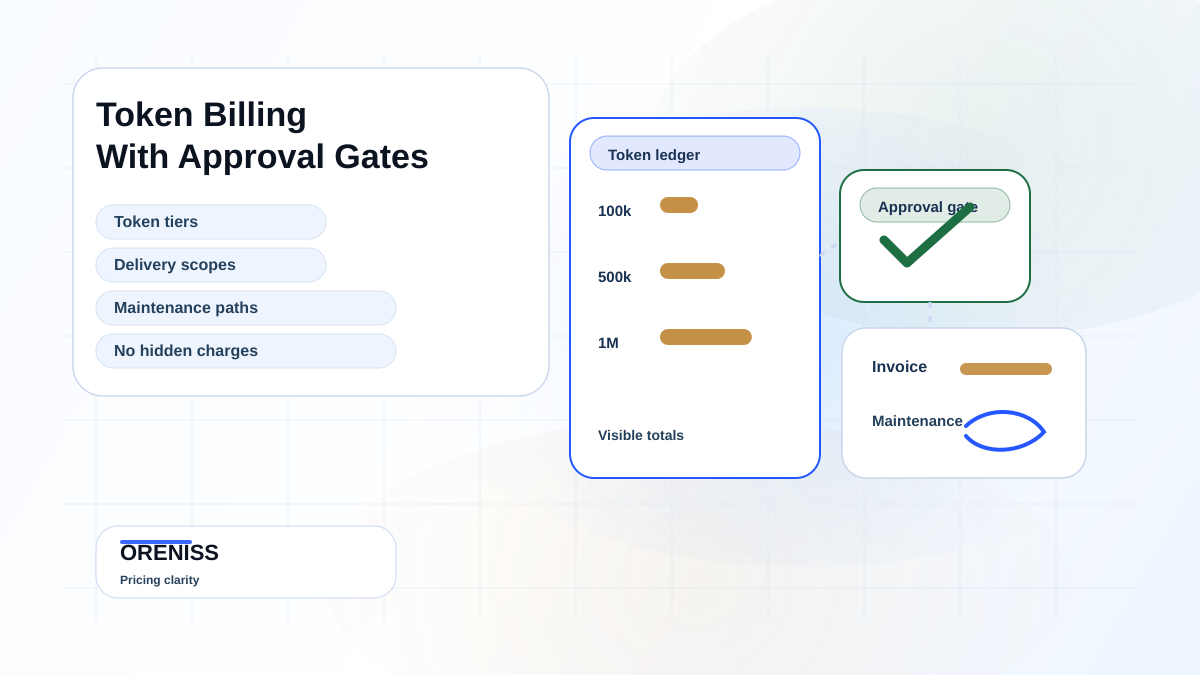
A fixed build is estimated, reviewed, and converted into a contract-backed invoice line only after scope, responsibilities, and the customer workspace path are accepted.
No intake form submission sets the final price.Access coordination, connector setup, content loading, and stakeholder review are separate setup items when they affect delivery cost.
No setup line becomes billable until explicitly approved.Repeat requests and agent-run batches draw from an approved Oreniss Token balance in the local Oreniss ledger.
Tier discounts, purchases, and token debits require checkout or approval review.Local invoice lines define what Stripe should execute in test mode first, including hosted invoice links and tax-ready values.
No live Stripe mutation happens without explicit target approval.After launch, support can continue in the same workspace as reserved capacity, token-funded tasks, or approved support invoice lines.
Maintenance work stays tied to the same workspace, approval history, and billing context.Nominal token pricing starts at USD 1.00 per token before tier discounts and tax. Approved agentic work consumes tokens from the customer balance as runs and tasks are executed, recorded, and reconciled.
The public package math uses the token count, the nominal unit price, and the published tier discount.
Five purchase options discount the nominal package by 0, 10, 20, 30, or 40 percent.
Approved runs, task batches, and maintenance work debit tokens according to recorded execution and review state.
Stripe can execute hosted checkout and tax, but local invoice, token, and approval state stay authoritative.
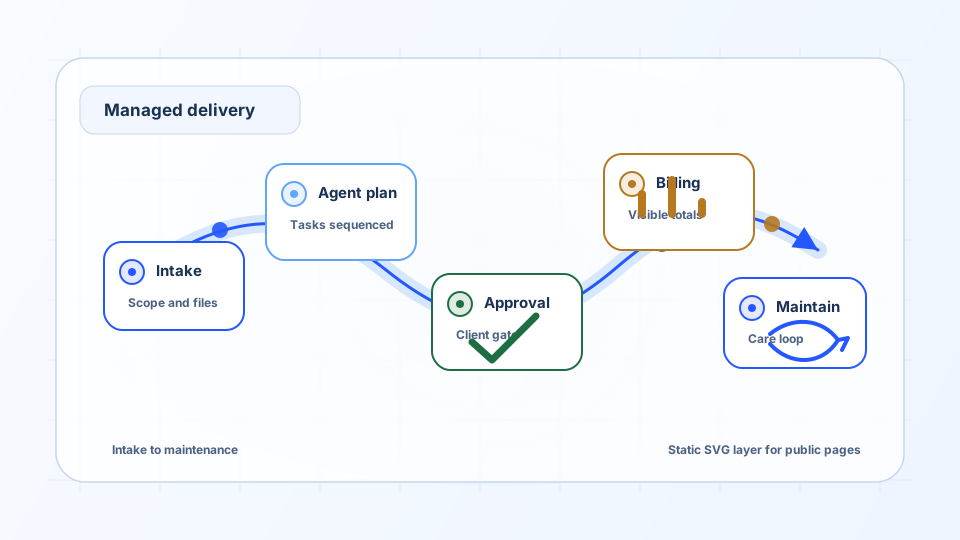
Catalog sync, checkout, invoices, tax handling, and webhook mapping are designed to run in Stripe test mode before live target confirmation. No live Stripe mutation is allowed without explicit target approval.
Oreniss local invoices, lines, and invoice events define what should be billed. Stripe is the downstream invoice, payment, and tax execution layer rather than the only source of billing truth.
Customers see billing status, issued invoices, hosted invoice links, token ledger entries, and case-specific billing context beside work items and messages.
Human-assisted setup, infrastructure coordination, and approval-required work items do not become invoice or token-debit candidates until the approval gate is satisfied.
Stripe tax calculation can be part of the planned invoice and checkout path when enabled, but customer identity, product tax behavior, and invoice values still start from the Oreniss local billing contract.
Completed delivery can move into maintenance through reserved capacity, Oreniss Tokens, or approved invoice lines without forcing the customer into a brand-new workflow.
No. Oreniss prices managed delivery outcomes, approved setup work, Oreniss Tokens, and maintenance rather than open-ended self-serve seats.
No. Example ranges help customers understand typical buying paths, but Oreniss still reviews the current environment and scope before issuing a firm bid or contract-ready price.
Oreniss Tokens cover approved repeat requests, maintenance, and agent-execution batches inside the same customer workspace. The portal keeps the approved token balance, ledger activity, invoices, and checkout state visible before any live billing action proceeds.
Assisted setup covers operator-coordinated access, content, installation, or secret-safe setup work. Oreniss Tokens cover approved execution capacity and task batches after the workspace and billing path are already in place.
Execution lines, assisted-delivery tasks, infrastructure work, maintenance changes, and contract changes move through explicit approvals before they become invoice or token-debit candidates.
Stripe is the checkout, invoice, and tax execution layer, but Oreniss keeps local billing, invoice, and token state authoritative. Stripe work stays test-mode first until an explicit live target is approved.
No. Pricing examples, token purchases, invoice candidates, Stripe checkout, and tax execution stay test-mode-first and approval-gated before any live billing target is used.