
Managed agentic delivery

Service delivery for global SMB teams that need the work finished

Oreniss combines scoped delivery, reusable customer workspaces, human-assisted setup, agentic execution, approvals, billing visibility, invoicing, and maintenance for teams that need websites, automations, integrations, and AI-agent workflows delivered without building a full internal engineering function first.

Positioning

A managed service path, not another isolated tool

Every service area follows the same operating model: confirm the need, keep visibility in one workspace, gate approvals and billing changes, and use human help where automation should stop.

01

Managed delivery, not builder seats

Oreniss is for teams that want the work scoped, executed, tracked, billed, and maintained rather than handed a prompt-heavy self-serve builder.

02

One reusable customer workspace

Requests, files, approvals, messages, billing, and maintenance stay connected inside one customer workspace instead of being scattered across disconnected tools.

03

Visible execution with human backup

Agentic workflows can carry the routine work, but a human operator can step in during setup, approvals, billing, contract changes, or maintenance when needed.

Workspace detail

What customers can understand before work starts

The services share one operating view: setup creates the workspace, approvals define what can move, execution shows safe progress, billing stays attached to the case, and maintenance continues after launch.
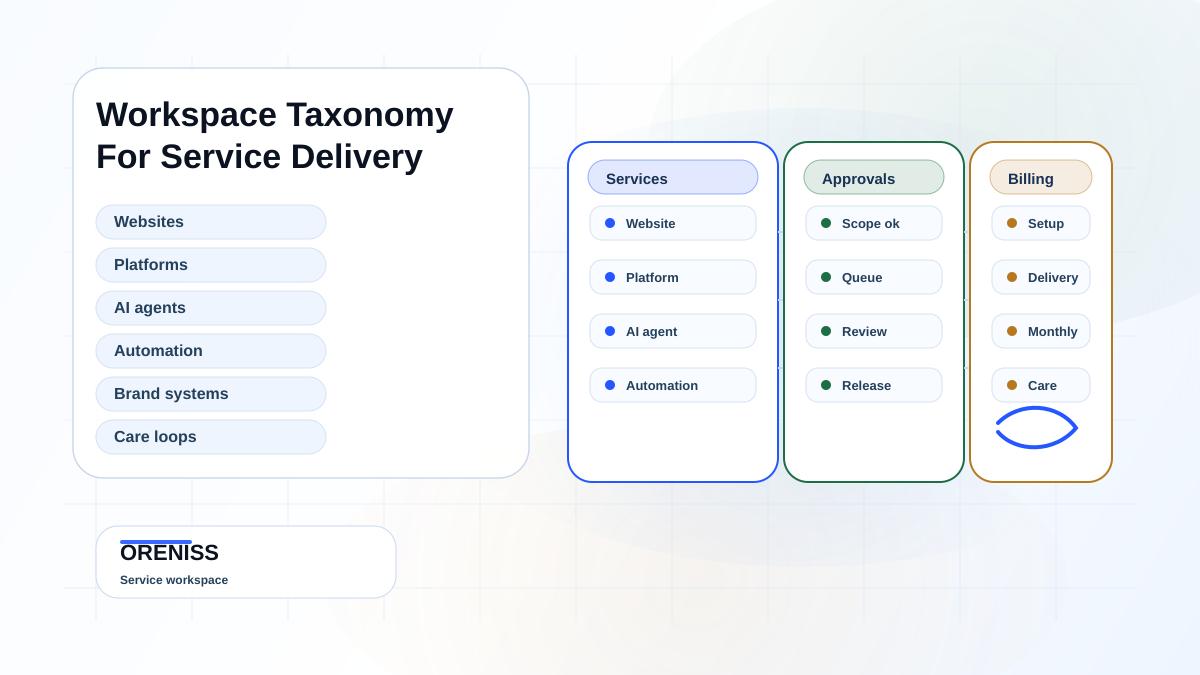
Customer workspace grid showing services, approvals, billing visibility, and maintenance
Foreground workspace graphic keeps service scope, approval gates, Oreniss Token billing visibility, and maintenance in one readable customer path. Outstanding Approved Contracted Executing Completed Maintenance
  1. Setup

    Workspace setup

    Oreniss creates or reuses one customer workspace with request folders, visible files, status, messages, and safe access notes before delivery begins.

    Customers see the request folder, intake context, visible files, and next needed action.
  2. Approve

    Approval gates

    Scope changes, assisted setup, customer-facing updates, and billable transitions stay behind explicit review instead of silent automation.

    Customers see whether work is waiting, approved, queued, or ready for review.
  3. Execute

    Delivery execution

    Website, portal, integration, automation, or agent work runs against the approved scope with artifacts and customer-safe progress attached to the case.

    Customers see execution status, files, messages, and handoff notes.
  4. Bill

    Billing visibility

    Invoices, Oreniss Token ledger entries, hosted payment links, and billable work items stay tied to the same case so customers understand what has been approved.

    Customers see invoice state, Oreniss Token balance, and case-linked billing context.
  5. Maintain

    Maintenance continuity

    Completed work can continue into support, repeat requests, fixes, and planned improvements without opening a separate operating path.

    Customers see maintenance history, support requests, and follow-up status.
Service taxonomy

Eight delivery areas, one managed path

Each card keeps the outcome, deliverable, example, and keyword structure visible so customers can scan what Oreniss can scope while the shared workspace, approval, billing, and maintenance model stays consistent.

Website Upgrades and Digital Surfaces

Build, rebuild, repair, or improve public websites, stores, landing pages, portals, and customer-facing product surfaces with scoped delivery and maintenance handoff.

Best for: Global SMB teams that need a public surface launched or improved, with request status, approvals, billing context, and upkeep handled without staffing a full internal web team first.

Outcomes

  • Launch faster with a clearer scope.
  • Improve conversion, trust, content clarity, and customer handoff.
  • Repair performance, accessibility, integration, and maintenance issues.

Deliverables

  • Page or flow audit
  • Scoped implementation plan
  • Rebuilt or improved surface
  • Customer-visible handoff notes

Service examples

  • Website rebuild for a service business with intake, CRM handoff, analytics, SEO, and a customer workspace trail.
  • Existing Shopify, Webflow, WordPress, or custom app fixes with visible work-item tracking.
  • Customer dashboard, booking, quote, document, or payment surfaces connected to current tools.

Keyword themes

website upgrade service managed website automation website portal upgrade service

Customer Portals and Shared Workspaces

Create customer dashboards, request portals, document views, account areas, and shared workspace flows with visible request, approval, billing, and maintenance state.

Best for: Teams that want customers to see status, files, billing context, and approved self-service actions without exposing internal admin systems.

Outcomes

  • Better visibility across requests and approvals.
  • Fewer support loops around files, status, and ownership.
  • Structured self-service without exposing internal CRM controls.

Deliverables

  • Portal shell and routing
  • Workspace tree and file views
  • Approval, billing, and message visibility

Service examples

  • Customer case dashboards with file trees, breadcrumbs, previews, and downloads.
  • Shared workspaces for one organization with one request folder per engagement.
  • Portal billing panels that show invoices, Oreniss Token balances, and case-linked billing context.

Keyword themes

customer portal development service client workspace portal service request portal development

AI Agents and Approval-Based Workflows

Set up AI agents for delivery, back-office tasks, approvals, follow-up work, and repeatable workflows with human review boundaries and visible execution state.

Best for: Operators who want automation with clear review boundaries instead of uncontrolled prompt-driven execution.

Outcomes

  • Lower manual load without uncontrolled automation.
  • Clearer routing and agent role separation.
  • Visible execution with approval gates.

Deliverables

  • Agent role definitions
  • Approval and escalation rules
  • Workflow status and digest surfaces

Service examples

  • Delivery-agent workflows for approved tasks, artifact generation, and customer-safe progress.
  • Customer-service agents that digest message churn into safe summaries and follow-up prompts.
  • Sales and billing agent roles that stop at approval and compliance boundaries.

Keyword themes

managed AI app delivery agentic workflow setup for business human-in-the-loop AI automation

Sales, Quote, and Contract Automation

Improve intake, qualification, quote generation, contract nudges, and request tracking so scope, approvals, and billing-ready handoffs stay visible.

Best for: Businesses that need better request intake and follow-up discipline without turning sales operations into another manual inbox queue.

Outcomes

  • Shorter response time for qualified requests.
  • More consistent follow-up without raw outbound automation.
  • Better scope control before delivery begins.

Deliverables

  • Request intake and lookup flows
  • Quote and contract follow-up rules
  • Customer-safe CRM timeline digests

Service examples

  • Returning-customer lookup with verified company identifiers and read-access token issuance.
  • Quote follow-up candidates that stay internal until operator approval.
  • Contract-pending nudges that can become customer-safe delivery digests after review.

Keyword themes

AI sales workflow automation quote and contract workflow automation bid qualification agent

Customer Service and Maintenance Automation

Add support intake, case summaries, maintenance workflows, and customer update loops that keep post-launch work tied to the original workspace and billing trail.

Best for: Teams that need post-launch support and recurring improvements to stay visible, scoped, and billable only when approved.

Outcomes

  • Faster support triage and follow-up.
  • Cleaner handoff from delivery into maintenance.
  • Visible customer updates without raw comms leakage.

Deliverables

  • Support intake and case summaries
  • Maintenance workflow rules
  • Customer-safe message digests

Service examples

  • Support intake linked to an existing case, workspace, and maintenance trail.
  • Case summaries that reduce operator handoff time between delivery and support.
  • Maintenance loops that combine repeat requests, approvals, and billing visibility.

Keyword themes

AI customer service agent setup support workflow automation service post-launch maintenance partner

Integrations, Backend Systems, and Operations Dashboards

Connect APIs, billing systems, data rooms, internal tools, and SMB dashboards with customer-safe wrappers over approval and billing events.

Best for: Organizations that already have live systems and need them connected without rebuilding everything from zero.

Outcomes

  • Less duplicate work across disconnected systems.
  • Stronger internal visibility and handoff reliability.
  • Safer operations around approvals, files, and billing events.

Deliverables

  • API and billing integrations
  • Workspace and data-room wrappers
  • Operations dashboard surfaces

Service examples

  • Backend integrations between request intake, CRM, workspace, and billing systems.
  • Customer-safe wrappers over internal data-room tree, grid, and file-content APIs.
  • Operations dashboards that show case, billing, and execution state in one place.

Keyword themes

API integration service business system integration for SMBs SMB operations dashboard setup

Billing, Invoicing, and Oreniss Token Operations

Implement billing visibility, Oreniss Token ledger flows, invoices, payment surfaces, and customer billing context that remain tied to approved delivery work.

Best for: SMBs that need billing tied directly to scoped delivery, approvals, invoices, and repeat-request Oreniss Tokens.

Outcomes

  • Clearer revenue operations tied to delivery.
  • Fewer billing surprises for operators and customers.
  • Tax-aware invoice handling with local authority retained.

Deliverables

  • Oreniss Token catalog and ledger logic
  • Invoice and hosted-payment visibility
  • Stripe test-mode-first payload contracts

Service examples

  • Oreniss Token catalogs with deterministic 50 percent gross-margin pricing by default.
  • Invoice headers, lines, and event flows synced from local authority into Stripe payloads.
  • Portal billing panels that expose safe invoice and Oreniss Token visibility without Stripe internals.

Keyword themes

billing workflow automation customer billing portal implementation Stripe invoice integration service

Brand, Content, and Launch Assets

Produce service pages, schema-safe FAQs, launch content, visual assets, and delivery materials tied to the actual work and maintenance model.

Best for: Operators who want the public offer, FAQ system, and launch assets to stay aligned with the delivery model rather than drifting into agency filler copy.

Outcomes

  • Clearer sales messaging tied to real delivery scope.
  • Reusable service and launch assets.
  • Consistent public positioning across pages and workflows.

Deliverables

  • Service page content systems
  • FAQ and SEO structures
  • Launch-ready page and card copy

Service examples

  • SEO service taxonomies tied to real internal categories instead of disconnected marketing claims.
  • FAQ systems that clarify managed delivery, approvals, billing, and maintenance.
  • Launch copy and asset packs that carry across home, services, pricing, and customer portal surfaces.

Keyword themes

service page SEO content launch content system brand system updates

How is Oreniss different from self-serve AI app builders?

Self-serve tools help customers prototype. Oreniss packages the business request, delivery workspace, agent execution, human assistance, approvals, billing visibility, invoicing, and maintenance into one managed service path.

Can Oreniss work inside an existing system?

Yes. Oreniss can scope work against an existing website, codebase, tool stack, or business workflow. Access is handled through approved case setup and customer-safe workspace boundaries.

What can customers see?

Customers can use the portal to see case status, request folders, visible files, agent runs, messages, Oreniss Token balance, invoices, and maintenance state without exposing internal CRM controls.

Do we need to replace our current tools before Oreniss can help?

No. Oreniss can scope work against an existing website, codebase, portal, CRM, billing stack, or operations flow and improve it in place when that is the right delivery path.

Can Oreniss handle both delivery and ongoing maintenance?

Yes. A project can move from scoped delivery into repeat-request Oreniss Tokens or a maintenance path without forcing the customer to restart in a new system or workspace.

How do approvals work when humans need to step in?

Approval gates protect both sides. Customer-visible updates, assisted setup tasks, infrastructure work, contract changes, and billable transitions stay behind explicit review rather than being pushed through silently.